From Uniswap to SushiSwap: A Deep Dive into Ethereum's DEX Ecosystem
A comparison of the leading Ethereum decentralized exchanges: how Uniswap, SushiSwap, PancakeSwap, Curve and Balancer differ, what their trade and user data showed in a 2024 snapshot, and one query that returns today's numbers.
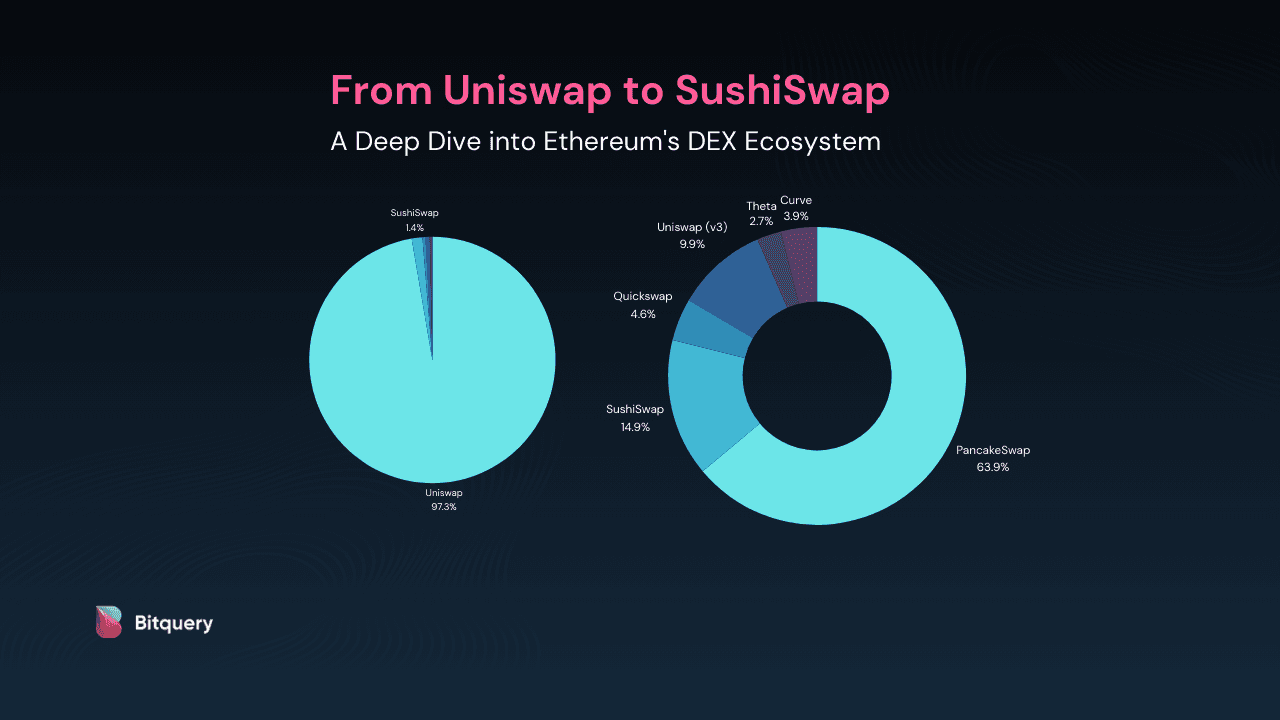
Decentralized exchanges (DEXs) have become a fundamental component of the Ethereum ecosystem. Unlike centralized exchanges, which match buyers and sellers through a central operator and hold users' funds, DEXs run as smart contracts: users keep custody of their assets throughout and trade straight from their wallets.
This piece compares the leading venues and then looks at what on-chain data says about them. The charts are a snapshot taken in March 2024 and are kept as published; the query at the end returns the same comparison for the last 24 hours whenever you run it.
Top 5 Decentralized Exchanges (DEXs): A Comparative Overview
DEXs facilitate peer-to-peer trading without intermediaries, offering greater control over assets. Here is a breakdown of the top five players on and around Ethereum and what sets them apart.
1. Uniswap: The Established Giant
Uniswap is the largest DEX on Ethereum. Its core is the automated market maker (AMM) model, where liquidity pools replace order books, so a swap never waits for a matching order. Three versions run side by side: v2 with simple constant-product pools, v3 with concentrated liquidity and fee tiers, and v4, launched in early 2025, which keeps every pool inside one PoolManager contract and lets pool creators attach hooks that customise swap and liquidity logic. Uniswap also runs on Base, Arbitrum, Optimism, Polygon and BNB Chain, and its pool model has been forked by most other AMMs.
2. SushiSwap: Fork with a Twist
SushiSwap began as a fork of Uniswap v2 and carved its own niche with the SUSHI token, which rewards liquidity providers and carries governance rights. It runs v2-style and v3-style pools across many chains and routes trades across them. Because its pools use the Uniswap pool interfaces, on-chain data providers classify them by protocol interface and factory rather than by brand, a detail that matters when you query them.
3. PancakeSwap: The BNB Chain Heavyweight
PancakeSwap is the dominant DEX of BNB Chain and also deploys on Ethereum, Base and Arbitrum. It uses the same AMM model and adds yield farming, prediction games and NFT features. Its newest version, PancakeSwap Infinity, follows the Uniswap v4 design with a singleton contract and hooks. Fees on BNB Chain are lower than on Ethereum mainnet.
4. Curve Finance: Stablecoin Specialist
Curve focuses on deep liquidity and efficient swaps between assets meant to trade at par: stablecoins such as USDC and DAI, and pegged assets such as wrapped or staked ETH. Its pricing curve is tuned to keep slippage minimal for those pairs, so it is the venue of choice for stablecoin-heavy strategies.
5. Balancer: The Customizable AMM
Balancer generalises the AMM: pools can hold up to eight tokens with custom weightings, which allows index-like pools and more elaborate liquidity strategies. Balancer v3 rebuilt the protocol around a vault that holds all pool funds, with pool types plugged in as modules.
DEX Trading Comparison by Number of Trades and Trade Growth over 24 hrs
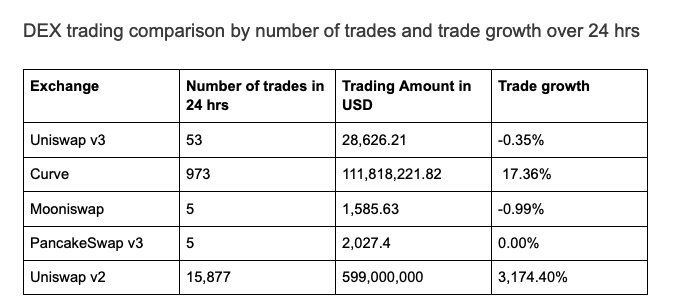
The above table shows trades done over 24 hours in the top 5 DEXs. We see that Uniswap v2 has the most growth exceeding 3,147 % with the largest trading volume in that period followed by Curve.
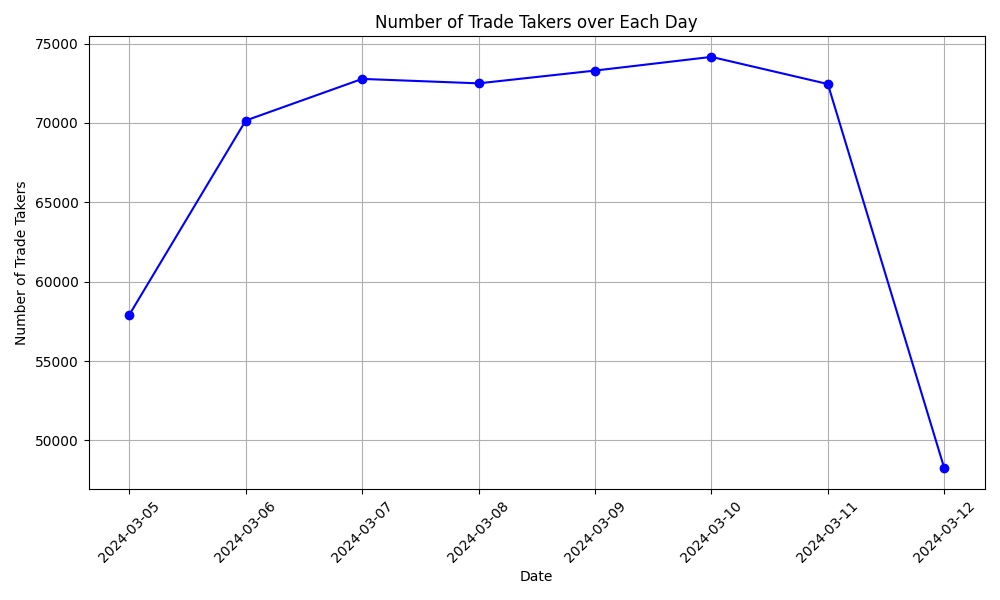
Moreover, while looking at comprehensive stats, the following plot depicts the number of trade takers recorded over seven days, from March 5th, 2024 to March 11th, 2024, suggesting a general increase from around 55,000 trade takers on March 5th to nearly 75,000 on March 11th.
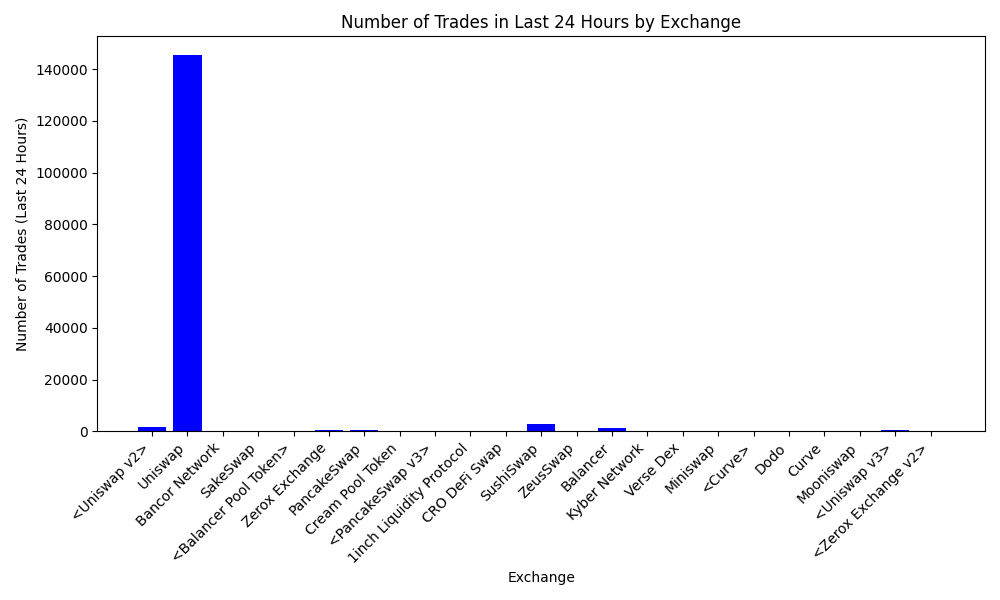
DEX Trading Volumes in Two Months
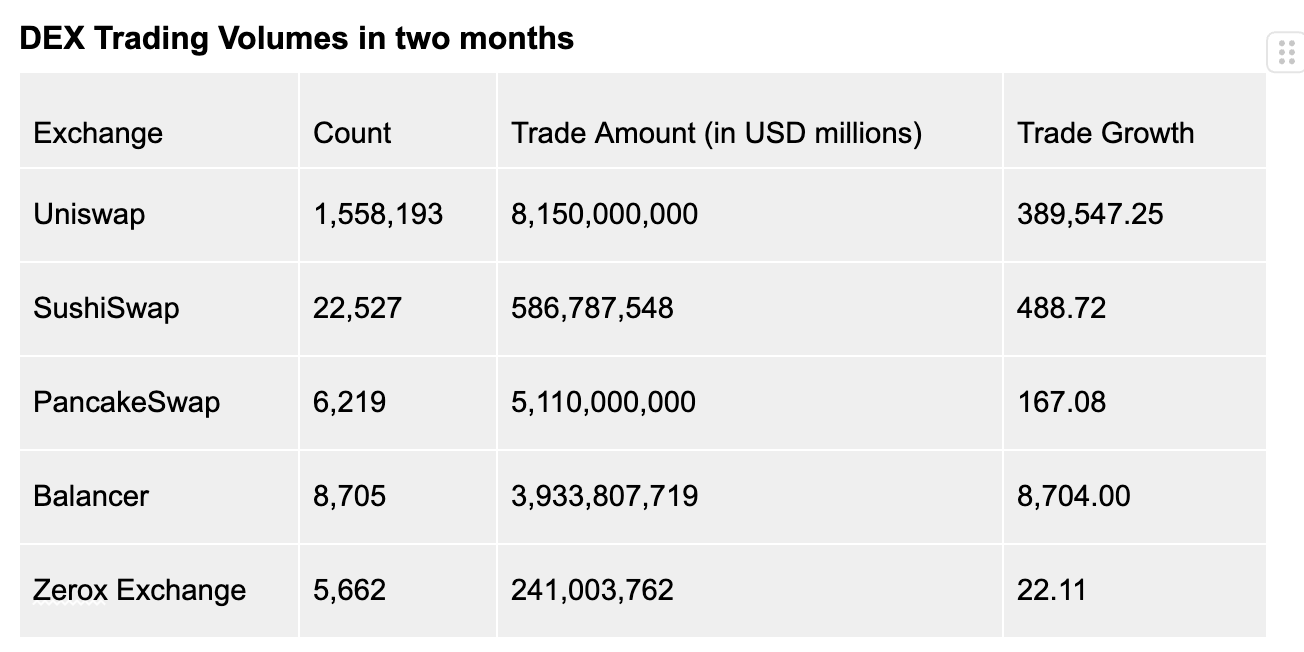
Using Bitquery DEX API, we can analyze top 5 decentralized exchange (DEX) platforms by trading volume. Uniswap leads the list with over 1.5 million trades and a staggering trade amount of $94.27 billion, experiencing a trade growth of 389,547.25%. SushiSwap follows closely with 22,527 trades and $105.72 billion in trade volume. PancakeSwap, Balancer, and Zerox Exchange also demonstrate significant trading activities. These DEX platforms are central to the decentralized finance (DeFi) ecosystem, providing users with decentralized trading options for various cryptocurrencies and tokens.
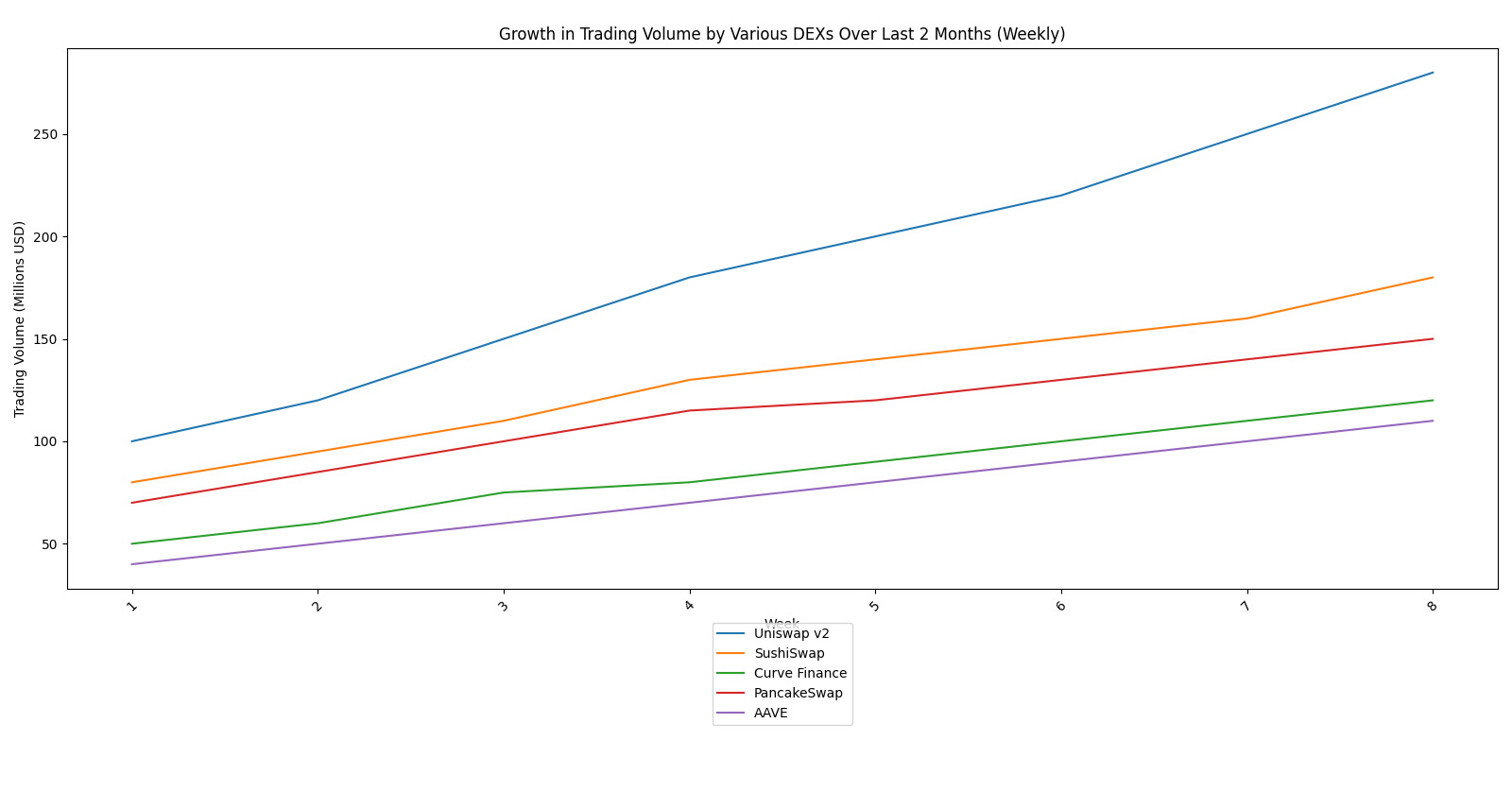
The growth trend is also in favor of UniswapV3. Nonetheless, SushiSwap and Curve Finance exhibit significant trading volume. This indicates they are strong contenders attracting a sizeable portion of DEX users.
Dex Daily User Activity: A Snapshot of a Week
Decentralized Exchanges (DEXs) are becoming increasingly popular for trading cryptocurrencies without relying on centralized platforms. Understanding user activity across different DEXs can be insightful for investors and developers. This analysis looks at the estimated total number of users on various DEXs in the last 24 hours,
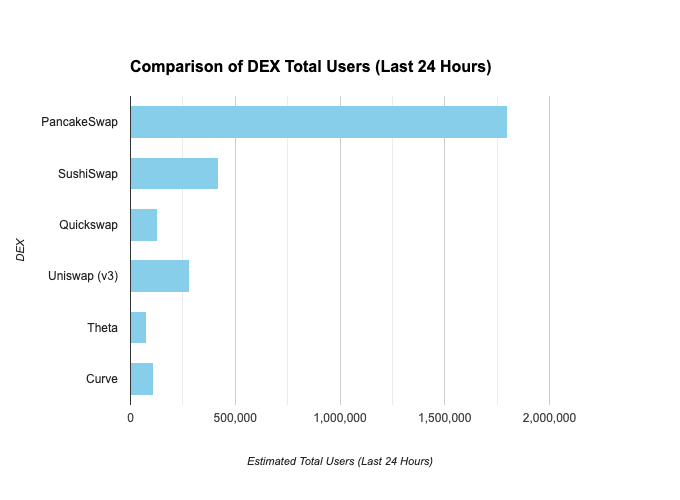
The dominance of PancakeSwap with an estimated 1.8 million users in the last 24 hours. SushiSwap follows with a significant presence at 420,000 users. Uniswap (v3) and Quickswap hold positions as established players with user bases exceeding 200,000 in this hypothetical day. Curve and Theta round out the chart with user estimates of 110,000 and 75,000 respectively.
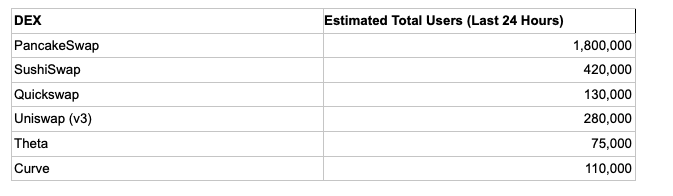
While this data offers a snapshot, it highlights potential trends. PancakeSwap's substantial user base suggests it caters to a broader audience or offers features attractive to a larger user pool. SushiSwap's strong presence indicates its continued relevance in the DEX landscape. Notably, Uniswap (v3) figures suggest healthy user adoption despite being a newer version of the popular Uniswap protocol.
Upward trends are present but not as significant as those of Uniswap v2. Events such as the launch of Uniswap v3 in the past and PancakeSwap Infinity could be contributing factors.
Examining various metrics like user growth, trading volume, and trade count provides a multi-faceted view of Decentralized Exchange (DEX) popularity. While Uniswap v2 emerges as a leader in several aspects, with the highest user growth and potentially the most trade volume and taker activity within the analyzed periods, other DEXes like SushiSwap, PancakeSwap, and Curve Finance hold significant presence as well.
The dominance of DEXs in the trade count metric further suggests a potential shift in user preference towards decentralized trading platforms. It's important to remember that the data represents limited timeframes, and long-term analysis would be needed to confirm these trends. Additionally, factors like specific DEX features, external market conditions, and user behavior should be explored for a more comprehensive understanding of the evolving DEX landscape.
Get today's numbers
The snapshot above ages; the comparison itself does not. This query on the Crypto Trades API returns, for the last 24 hours on Ethereum, the transactions, distinct traders and USD volume of every protocol family, largest first. It excludes Seaport, which is an NFT marketplace rather than a DEX and would otherwise appear in the list.
query EthereumDexComparison24h {
  Trading {
    Trades(
      where: {
        Pair: {
          Market: {
            NetworkBid: { is: "bid:eth" }
            ProtocolFamily: { notIn: ["Seaport"] }
          }
        }
        Block: { Time: { since_relative: { hours_ago: 24 } } }
      }
      orderBy: { descendingByField: "usd" }
      limit: { count: 10 }
    ) {
      Pair {
        Market {
          ProtocolFamily
        }
      }
      trades: count(distinct: TransactionHeader_Hash)
      traders: uniq(of: Trader_Address)
      usd: sum(of: AmountsInUsd_Quote)
    }
  }
}
Three notes on reading it. Transactions are counted by distinct hash because one swap can produce several rows. USD volume sums the quote leg, which is the reliable one. And SushiSwap does not appear as its own family: its pools use the Uniswap pool interfaces, so its trades are labelled uniswap_v2 and uniswap_v3 under the Uniswap family, and you separate them by filtering Market.Address to SushiSwap's factories, as shown in the SushiSwap APIs post. Change bid:eth to bid:base, bid:arbitrum or bid:bsc for the same table on another chain. The DEX API covers the venues behind every row.
Blog written by Kshitij M
Subscribe to our newsletter
Subscribe and never miss any updates related to our APIs, new developments & latest news etc. Our newsletter is sent once a week on Monday.